
We get asked about restaurants constantly. We have a whole guide to them. What almost nobody asks is where to drink, and that’s the gap worth filling, because drinking in Lisbon is not really about bars. It’s about a counter at 11am, a park bench at 6pm, a shot of cherry liqueur taken standing in a doorway, and a bottle of green wine that costs less than a cappuccino in London.
None of that requires a reservation, a dress code, or a plan. It does help to know how it works.
First, How to Order
Three phrases will get you almost everywhere.
Uma imperial is a small draught beer, around 20cl, served cold and fast. Ask for a fino and you have outed yourself as someone who learned Portuguese in Porto. If you want a bigger one, ask for uma caneca (half a litre).
Um copo de tinto or branco is a glass of red or white house wine. In an ordinary neighbourhood place this costs somewhere between one and two euros and is usually perfectly good. In a tasca, the house bottle (vinho da casa) tends to land around ten to fourteen euros.
Uma bica is an espresso, and the reason we mention coffee in a drinks guide is that in Lisbon the same counter serves both, all day, to the same people. There is no line between the café and the bar. Our coffee guide covers the daytime half of that.
One habit worth copying: stand at the counter. In most places the counter price and the terrace price are different, sometimes by double. Locals drink standing up, in five minutes, and leave.
The Ginjinha: A Drink That Takes Sixty Seconds
Ginjinha is sour cherry liqueur, sweet and thick and about 20% alcohol, and drinking one is less a night out than a small ritual you can complete on your way somewhere else.
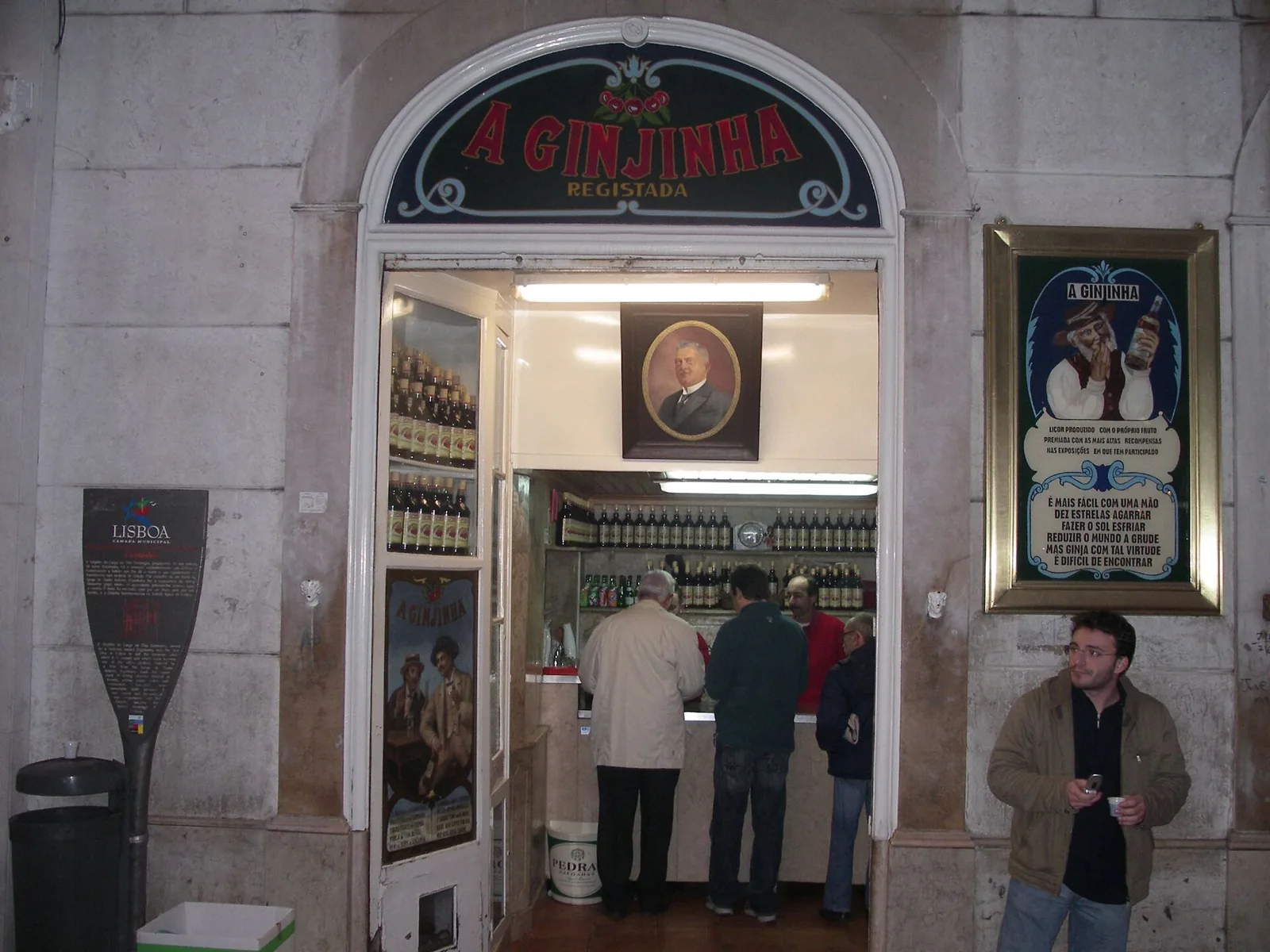
A Ginjinha at Largo de São Domingos, just off Rossio, has been pouring it since 1840 out of a doorway barely wide enough for two people. You order at the hatch, you get asked com ou sem elas (with or without the cherries; say com), you pay a euro and change, and you drink it on the pavement in a square full of people doing exactly the same thing. The whole transaction takes a minute.
Ginjinha Sem Rival, around the corner on Rua das Portas de Santo Antão, is the same idea with a beautiful 1920s interior and a second house speciality, an anise liqueur called Eduardino, which is an acquired taste worth acquiring.
Our tip: do this before dinner, not after. Ginjinha at 7pm on the way to a restaurant is a Lisbon thing. Ginjinha at midnight is a headache.
If you get to Óbidos on a day trip, you’ll find it served in a small cup made of chocolate, which is either delightful or a lot, depending on your mood.
The Kiosk: The Best-Value Hour in the City
If we could send guests to one kind of place, it would be a quiosque.
These little cast-iron kiosks were a fixture of 19th-century Lisbon, selling water, lemonade and gossip in the city’s squares. Most of them rotted away or were boarded up. From 2009 onwards they were systematically restored and reopened, and they have quietly become the best thing about the city’s public spaces: a kiosk, a dozen metal chairs under a tree, a beer for a couple of euros, and no music.
Order a beer or a glass of white, or go local and try the old kiosk drinks: capilé (a syrup made from maidenhair fern, served with lemon), mazagran (cold espresso with lemon and ice, invented by soldiers and better than it sounds) or groselha (redcurrant cordial, what Portuguese children drink).
The ones we use most:
- Príncipe Real garden, under the enormous spreading cypress. Shady, green, full of dogs and toddlers.
- Jardim da Estrela, opposite the basilica, with a bandstand and a lake.
- Praça das Flores, small and residential and almost entirely local.
- Ribeira das Naus, on the river between Cais do Sodré and Praça do Comércio, where the pavement steps down into the Tagus.
- Miradouro de São Pedro de Alcântara and Portas do Sol, for the version with a view.
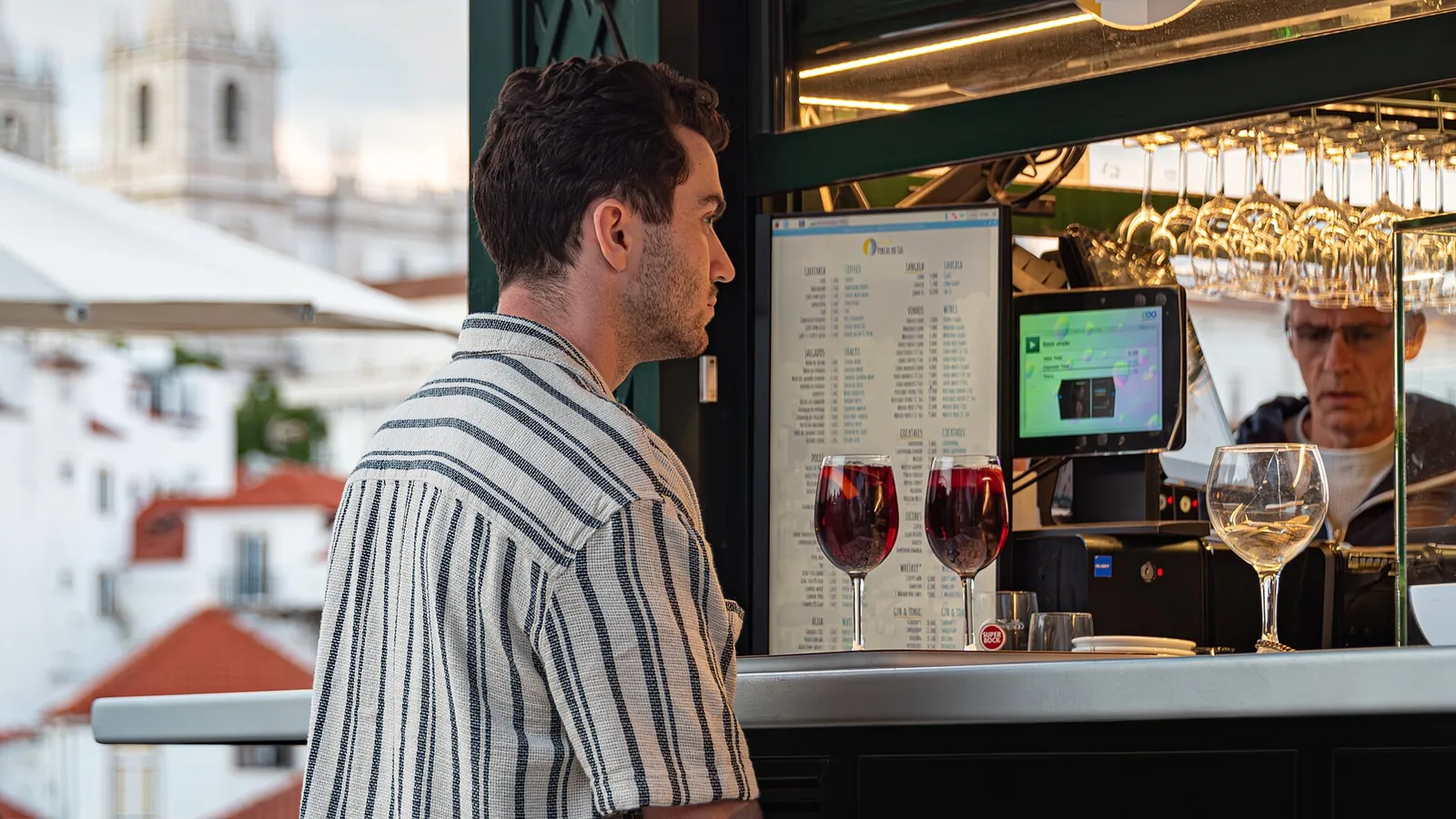
Our tip: the kiosks at the miradouros are the honest alternative to a rooftop bar. Same view, a third of the price, no queue, no bouncer.
The Cervejaria: Beer and Shellfish
A cervejaria is a beer hall, and in Lisbon it usually means beer plus seafood, eaten late, under bright lights, with paper tablecloths and a lot of noise. It is one of the city’s great institutions.
Cervejaria Ramiro on Avenida Almirante Reis is the famous one, and deservedly so: garlic prawns, gambas da costa, percebes if you’re brave, and a steak sandwich at the end that they call dessert. There is always a queue. Take a number, go for a beer nearby, come back.
Cervejaria Trindade in Chiado is worth it for the room alone, a former convent refectory lined floor to ceiling with 19th-century tiles. The food is fine rather than remarkable. Go for a beer and the walls.
Ribadouro on Avenida da Liberdade is where people who work in the offices around it go, which is a decent endorsement.
Portuguese lager is Sagres or Super Bock, and the difference between them is the kind of thing people will argue about with you happily for an hour. If you want something more interesting, Lisbon has a genuine craft scene concentrated in Marvila and Beato, the old warehouse districts east of the centre, where breweries like Dois Corvos and Musa run taprooms in industrial units. It’s a completely different Lisbon from the postcard one and a good Saturday afternoon.
Wine: What to Drink, and Where
Portugal has more indigenous grape varieties than almost anywhere, and the ones you’ll be offered in Lisbon are mostly not the ones exported. That’s the fun of it.
Worth ordering:
- Vinho Verde from the north, light and faintly fizzy. The serious end (Alvarinho, Loureiro) is a proper wine, not just a holiday one.
- Alentejo reds, warm and round and the default red in most of the city.
- Douro reds, structurally the same land as port, some of the best wine in Europe.
- Bucelas, a crisp Arinto white grown twenty kilometres north of Lisbon that most visitors never hear of.
- Colares, grown in sand on the Sintra coast on ungrafted vines that survived the phylloxera plague. Rare, strange, expensive, and a story in a glass.
- Moscatel de Setúbal, sweet and orange-peel scented, the thing to drink after dinner instead of port.
Where to drink it: By the Wine on Rua das Flores, under a vaulted ceiling covered in thousands of bottles, is touristy and still very good. Garrafeira Alfaia in Bairro Alto is a tiny old shop with a handful of tables and encyclopaedic staff. Wine Bar do Castelo, up near the castle, is run by a man who will happily talk you through a dozen glasses if you let him.
Our tip: in any of these, don’t order from the list. Say roughly what you like, say what you’re spending, and let them choose. This works better in Portugal than almost anywhere.
The Bairro Alto Question
Every guide sends you to Bairro Alto. Here’s the honest version.
By day it’s a quiet grid of steep, narrow streets with shuttered doors and washing lines. Around nine or ten in the evening the shutters roll up and it turns into perhaps two hundred tiny bars, most of them barely bigger than a living room, none of them with space to sit. You buy a drink, you take it into the street, and the street becomes the bar. Around two in the morning it closes and the crowd walks downhill to Cais do Sodré.
It’s genuinely fun, and it’s genuinely not for everyone. On a Friday in August it is loud, very young, and thick with stag parties. If that’s not your holiday, go on a Tuesday, go early, or go elsewhere. The good news is that “elsewhere” is excellent:
- Príncipe Real for the grown-up version. Pavilhão Chinês on Rua Dom Pedro V is the one to see: five rooms of an old grocery shop filled floor to ceiling with glass cabinets of toy soldiers, model aeroplanes, teapots and colonial bric-a-brac, waiters in waistcoats, and a menu of a few hundred cocktails. Ring the bell to get in.
- Cais do Sodré for the reformed red-light district. Rua Nova do Carvalho is painted pink end to end and known to everyone as Pink Street. Pensão Amor, a former brothel done up in velvet and murals, is worth walking through even if you don’t stay. Sol e Pesca, an old fishing tackle shop, now serves tinned fish and beer at the counter.
- Intendente for where Lisbon actually goes. Ten years ago this square was somewhere you avoided. Now Casa Independente, a faded old apartment turned into a bar with a courtyard, is one of the nicest places in the city to spend an evening.
- Marvila for beer, as above.
Rooftops, Honestly
Lisbon is built on hills, so a rooftop bar here has an unfair advantage. Park, on the top deck of a multi-storey car park on Calçada do Combro, is the best of them: you go in through the car park entrance, take the lift to level six, and walk out into a garden terrace looking straight at the river and the bridge. Topo Chiado puts you eye level with the ruined arches of the Carmo convent.
Both are busy, both charge more than the view is strictly worth, and both are worth doing once. Go at seven, not at nine, and don’t expect a table.
And if there’s a queue, remember the kiosk rule above. There is almost always a miradouro within ten minutes with the same sunset and a two-euro beer.
After Dinner
Portuguese meals end with a small glass of something. Aguardente (grape spirit, fierce), medronho (from arbutus berries, more fierce, usually from the Algarve), Licor Beirão (herbal, sweet, on every shelf in the country), Moscatel or a glass of port. If you’re in a tasca and you’ve been friendly, this arrives without being ordered and without appearing on the bill.
Practical Things
Prices. An imperial at a neighbourhood counter is usually a little over a euro, and three to five on a terrace in Chiado. A glass of house wine, one to three. A cocktail in a proper cocktail bar, ten to fourteen. Ginjinha, about a euro fifty. These drift, but the ratios hold.
Paying. In old-school places you pay at the end, at the counter, and it’s fine to run a tab without being asked. Small places may still be cash only.
Getting home. The metro’s last trains run around 1am, which is exactly when Bairro Alto gets going. Plan for a taxi or an Uber, or factor it into where you choose to stay. Ubers around Cais do Sodré at 2am surge hard; walking five minutes up the hill before ordering one saves real money.
Noise. Almost every bar in the centre has people living above it. Lisbon’s residents are extraordinarily tolerant, and the way to repay that is to be quiet in the street after eleven. We say this as hosts whose neighbours are lovely people who get up early.
If You Only Have Three Evenings
One: ginjinha at São Domingos, dinner in Baixa, then a kiosk at São Pedro de Alcântara for the sunset over the castle.
Two: a wine bar in Cais do Sodré, then a wander through Pink Street to see it, then early to bed. Or not.
Three: Ramiro for prawns and beer at 9pm, then a slow drink somewhere in Príncipe Real.
None of that costs much, and none of it requires booking anything. That’s rather the point.
If you want the music that goes with the wine, our guide to fado explains how to find a real fado house rather than a dinner show. And if you’re here in the heat, the August guide covers where to drink outdoors when it’s 35°C.
Staying with us? Every one of our apartments has a corner shop, a kiosk and a decent local bar within a few minutes’ walk, and we’re happy to point you at ours. Our guide to the neighbourhood we live in covers the rest of it. Browse our apartments and book direct.
Image credits: A Ginjinha, Largo de São Domingos, by Shadowgate (CC BY 2.0); Quiosque das Portas do Sol by Jorge Franganillo (CC BY 2.0). Both via Wikimedia Commons.