
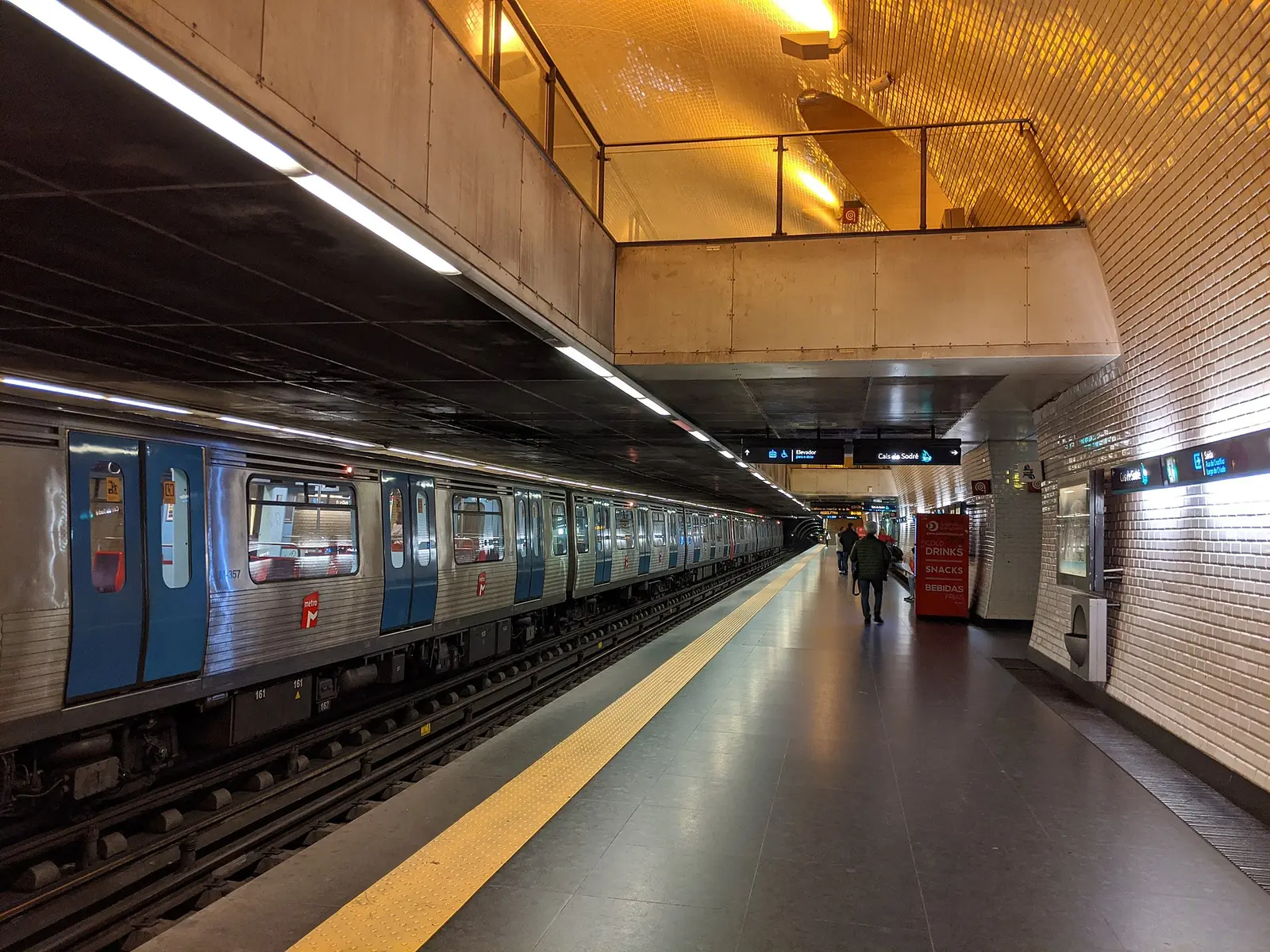
Lisbon’s trams get the photographs, but the metro does the work. It’s clean, cheap, frequent and, once you understand its four lines, very simple. Most of the questions our guests ask on their first evening are about it: which ticket, which line, where to change, whether it goes to Belém. (It doesn’t. More on that below.)
Here’s the guide we’d give a friend arriving for the first time. Fares and timetables are the ones in force in 2026; they usually change in January, so if you’re reading this in a later year, check the current figures before you rely on them.
The Four Lines in Two Minutes
The network is small: four colour-coded lines, 56 stations, open every day. You only really need to know where each line goes and where they meet.
Blue line. Runs from Reboleira in the west to Santa Apolónia station on the river. In the centre it calls at Marquês de Pombal, then down Avenida da Liberdade to Restauradores, Baixa-Chiado and Terreiro do Paço. West of Marquês it serves the Gulbenkian (São Sebastião and Praça de Espanha), the zoo and the Sete Rios bus station (Jardim Zoológico), and Benfica’s stadium (Colégio Militar/Luz).
Yellow line. Runs north to south from Odivelas to Rato. This is the spine of the newer city: Campo Grande, Entrecampos, Campo Pequeno, Saldanha, Picoas, Marquês de Pombal and Rato, which is a short walk from Príncipe Real.
Green line. Runs from Telheiras down to Cais do Sodré on the river, via Alameda, the multicultural Intendente and Martim Moniz area, Rossio and Baixa-Chiado. Cais do Sodré is where you pick up the train to Cascais and the ferry across the river.
Red line. Runs from São Sebastião east to the airport, via Saldanha, Alameda, Olaias and Oriente, the station for Parque das Nações, the Oceanário and long-distance trains.
The six places where lines meet are the ones worth memorising:
- Marquês de Pombal: blue and yellow
- Baixa-Chiado: blue and green
- Saldanha: yellow and red
- Alameda: green and red
- São Sebastião: blue and red
- Campo Grande: yellow and green
With those six, you can get from any station to any other with at most one or two changes.
Coming in 2027? A new section of line linking Rato to Cais do Sodré, with new stations at Estrela and Santos, is due to open in the first quarter of 2027. It will turn the yellow and green lines into a central loop and change some routes, so if you’re travelling after it opens, look at the current map rather than relying on the one above.
Where the Metro Doesn’t Go
This is the part that trips people up. The metro was built to move residents, not tourists, and several of the places on every visitor’s list aren’t on it:
Belém has no metro. Take the 15E tram from Praça da Figueira or Praça do Comércio, or the Cascais-line train from Cais do Sodré, which is quicker.
Alfama and the castle sit on a hill above the network. Santa Apolónia and Terreiro do Paço get you to the bottom of Alfama, and Martim Moniz to the foot of the castle hill. From there you walk up, or let tram 28 do the climbing.
LX Factory and Alcântara are reached by train, tram or bus from Cais do Sodré.
Bairro Alto and Príncipe Real are close to stations (Baixa-Chiado for the first, Rato for the second) but there’s a hill involved either way. At Baixa-Chiado, take the Chiado exit: its long escalators do a good part of the climb for you.
Three Ways to Pay
1. Tap your bank card or phone. The easiest option for a short trip. Every metro station accepts contactless Visa and Mastercard cards, and phones or watches with Apple Pay or Google Pay, directly at the gates. A trip costs €1.92. Two rules: each person needs their own card or device (you can’t tap the same card twice for two people), and you need to use the same card or phone to exit that you used to enter. If your bank charges foreign transaction fees, factor that in.
2. The navegante card with zapping credit. This is what most locals use. Buy a reusable navegante ocasional card for €0.50 at any station machine (they have an English option and take cards and cash), then top it up with zapping credit. A metro trip on zapping costs €1.72, the cheapest single fare available. The same credit also works on Carris buses and trams, the ferries and the suburban trains to Sintra and Cascais, so one card covers almost your whole trip. The card is valid for a year, but it’s personal: one card per person, even within a family.
You can also load a single ticket (€1.90) onto the card instead of zapping. It’s valid for 60 minutes from when you first validate it, on the metro and the Carris network. For most visitors, zapping is simpler and cheaper.
3. The 24-hour ticket. Loaded onto the same navegante card, the Carris/Metro 24-hour ticket costs €7.25 and covers unlimited metro, buses, trams and the city’s funiculars and lift for 24 hours from the first use. It pays for itself quickly if your day includes a tram ride (a ticket bought on board a tram costs €3.30). There are also versions that add the Cacilhas ferry (€10.35) or the CP suburban trains to Sintra and Cascais (€11.40).
The catch nobody explains. A navegante card can only hold one type of ticket at a time. If it has zapping credit on it, you can’t add a 24-hour ticket until the credit is used up, and vice versa. If you want both, the easy fix is to buy a second card for €0.50.
Hours and How Often Trains Run
The metro runs every day from 6:30am to 1am, weekends and holidays included. As long as you pass through the gates before 1am, you’ll be carried to your destination on that line.
On weekdays, trains run roughly every four minutes at morning peak on the busiest lines, every six to eight minutes in the middle of the day (longer on parts of the yellow line), and every nine to ten minutes late in the evening. Weekend daytime service is a little less frequent. In practice, you rarely wait long enough to look at the timetable.
Rush hour is about 8am to 9:30am and again around 6pm to 7:30pm, and the yellow and green lines in particular get crowded. If you’re travelling with luggage or a pushchair, avoid those windows if you can.
From the Airport
The airport has its own station at the end of the red line, inside the terminal. From there, change at Saldanha for the yellow line (Marquês de Pombal, Entrecampos, Rato), at Alameda for the green line (Rossio, Baixa-Chiado, Cais do Sodré), or at São Sebastião for the blue line. Our airport guide compares the metro with taxis, Uber and the other options, and explains when the metro is the right choice and when it isn’t.
A Few Useful Journeys
To give you a feel for it, here are the trips our guests make most often:
- Marquês de Pombal to Baixa-Chiado: blue line, three stops. The quickest way into the historic centre from Avenida da Liberdade.
- Entrecampos to Baixa-Chiado: yellow line to Marquês de Pombal, then the blue line down. About fifteen minutes.
- Entrecampos to the airport: yellow line two stops to Saldanha, then the red line to the end.
- Baixa-Chiado to Cais do Sodré: green line, one stop, for the Cascais train or the ferry.
- Anywhere to Oriente: red line, for Parque das Nações and the Oceanário.
- Anywhere to Sete Rios: blue line to Jardim Zoológico, for the long-distance buses and the zoo.
Stations Worth a Second Look
The Lisbon metro is also, quietly, one of the city’s best public art collections. When the first stations opened in 1959, almost all of them were lined with tile designs by the painter Maria Keil, and that tradition of commissioning artists for every new or rebuilt station has continued ever since.
A few to look out for on your way past:
Parque, on the blue line just above Marquês de Pombal, was reworked in 1994 by the Belgian artist Françoise Schein. Its deep blue walls are covered in maps and texts about the Portuguese voyages of discovery and human rights. It’s also a short walk from our Castilho apartments, and worth stepping into even if you aren’t going anywhere.
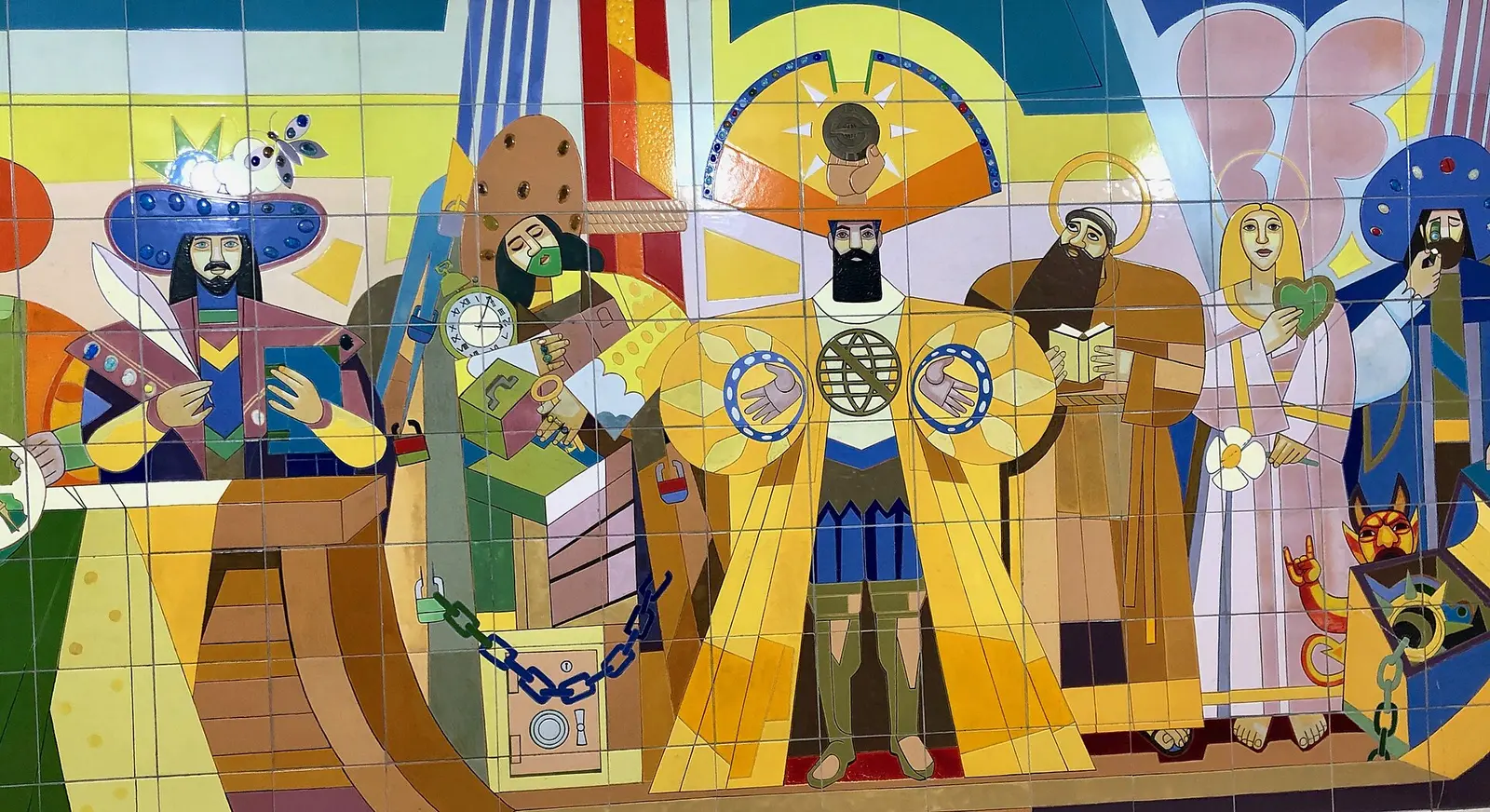
Restauradores, on the blue line, has a large, colourful tile panel called The Arrival, commissioned in 2000 for the 500th anniversary of the Portuguese arrival in Brazil.
São Sebastião and Picoas still have Maria Keil’s original patterned tiles, and Olaias, on the red line, is regularly listed among the most striking metro stations in Europe for its architecture.
Practical Tips
Keep your card until you’re out. You need it, or your bank card, to get through the exit gates as well as the entry ones.
Mind your pockets on crowded trains, particularly around Baixa-Chiado and on the airport line. Lisbon is a safe city, but busy carriages are where pickpockets work.
Luggage. Many stations have lifts, but not all, and some have long stairways between platforms and the street. If you’re arriving with heavy cases and a change of line, a taxi or an Uber is often the less stressful option.
Strikes (greves) happen from time to time. They’re announced in advance and can close the network for part or all of a day, so check the news if one is mentioned and have a plan B.
Matchdays. When Sporting play at home, the yellow line north of Entrecampos fills with green and white shirts; for Benfica, it’s the blue line out to Colégio Militar/Luz. It’s quite a sight, and worth knowing if you’re trying to get somewhere at the same time.
Where to Stay If You Want to Use It
The single biggest factor in how useful the metro is to you is how far you’re sleeping from a station. A five-minute walk to a station on a good line means the whole city is fifteen to twenty minutes away, the airport is one change away, and you’re never stuck waiting for a taxi on a wet night.
That’s exactly why we chose the locations we did. Our two Castilho apartments are a few minutes’ walk from Marquês de Pombal, where the blue and yellow lines meet, and our Entrecampos apartment is a short walk from Entrecampos, which has the yellow line and mainline trains to Sintra. Our Avenidas Novas guide explains what it’s like to live along the yellow line, and if you’re still deciding on an area, our neighbourhood guide compares the options.
Want to be near the metro? See our apartments near Lisbon metro stations, or browse all our apartments and book direct. Message us before you fly and we’ll help you plan the journey from the airport.
Image credits: Baixa-Chiado (Lisbon Metro) by Daniel from Glasgow, United Kingdom (CC BY 2.0); “The Arrival”, azulejos at Restauradores metro station, by Sonse (CC BY 2.0). Both via Wikimedia Commons.