
Lisbon is one of the most visually striking cities in Europe, and the reason is on every wall. Azulejos (the hand-painted ceramic tiles that cover facades, churches, staircases, and the sides of ordinary apartment buildings) have been part of the city’s identity for over five centuries. In recent years, a bold street art scene has grown up alongside them. You can experience both in a single morning on foot.
What Are Azulejos?
The word comes from Arabic (al-zulaij, meaning polished stone), and the tradition was introduced to Portugal in the 15th century. But azulejos were never just decorative — they insulate buildings against heat, reflect light into narrow streets, and resist the damp Atlantic air. Over the centuries, they became a medium for storytelling: religious scenes, historical events, and everyday life rendered in blue, white, yellow, and green.
Lisbon is the world capital of this art form. No other city has it on this scale.
Where to See the Best Azulejos
Igreja de São Vicente de Fora (Alfama)
One of Lisbon’s great churches, but the real treasure is in the cloisters. The 18th-century tile panels depict La Fontaine’s fables in extraordinary detail — animals, landscapes, and moral tales rendered in blue and white across entire walls. It’s one of the finest azulejo collections in the country, and far less crowded than you’d expect.
Our tip: Skip the church interior and go straight to the cloisters. The rooftop terrace also offers one of the best views in Alfama.
Museu Nacional do Azulejo (Madre de Deus)
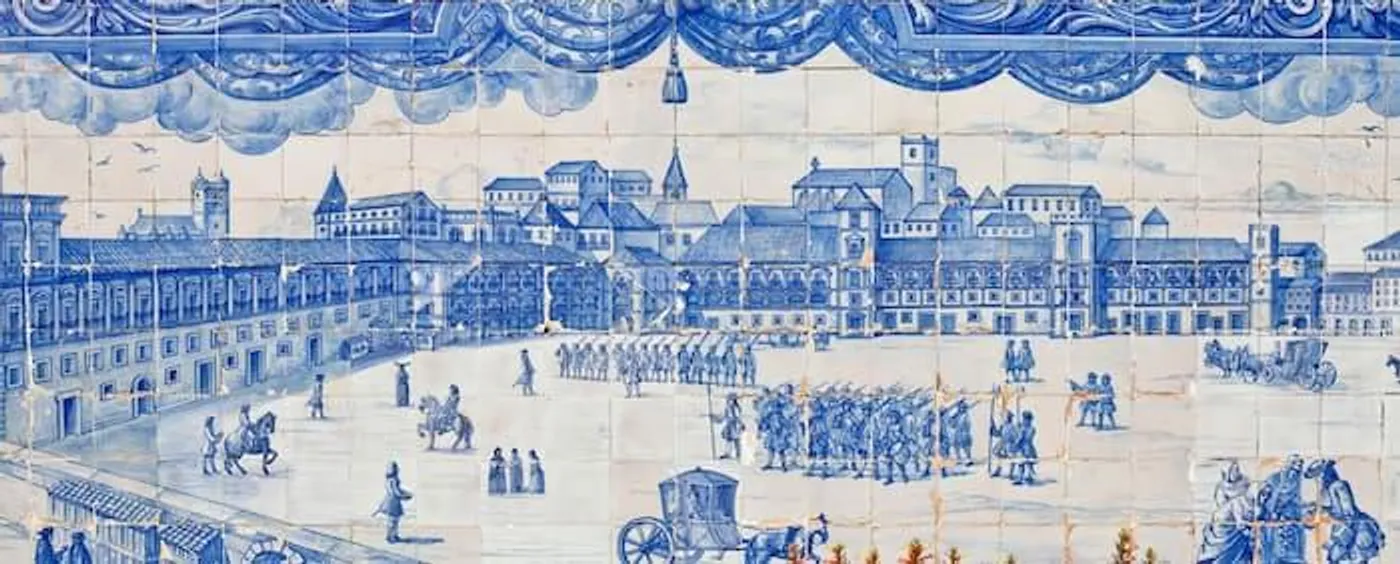
The only museum in the world dedicated entirely to tiles. Housed in a 16th-century convent, it traces the full history of Portuguese azulejos from Moorish geometric patterns to contemporary design. The highlight is a 23-metre panoramic tile panel showing Lisbon’s waterfront before the 1755 earthquake — a record of a city that no longer exists.
Best for: Anyone who wants to understand the full story in one visit. Allow 1.5 to 2 hours.
The Streets of Alfama & Mouraria
No museum required — just walk. The residential streets of Alfama and Mouraria are an open-air gallery of azulejos in every state: pristine 18th-century panels on church walls, faded domestic tiles on apartment facades, fragments of pattern half-hidden beneath peeling plaster. Look up, look into doorways, and follow the narrow lanes without a plan. The contrast between grand institutional tiles and humble domestic ones is part of what makes Lisbon unlike anywhere else.
Lisbon’s Street Art Scene
Over the past decade, Lisbon has become one of Europe’s most important cities for street art. The council’s Galeria de Arte Urbana (GAU) programme actively commissions large-scale murals, and the result is a city where world-class contemporary art sits alongside centuries-old tiles. The richest areas are Mouraria, Graça, and the corridors around Avenida Fontes Pereira de Melo.
Mouraria
The birthplace of Fado is now one of Lisbon’s most vibrant street art neighbourhoods. Start on Rua das Olarias and work your way through the narrow streets. Look for the carved-plaster portraits by Vhils (Alexandre Farto) — faces chiselled directly into building walls — and the animal sculptures by Bordalo II, assembled entirely from salvaged rubbish and painted in vivid colour.
Best for: Those who want raw, neighbourhood-level art that reflects the community it sits in.
Graça & Penha de França
Quieter than Mouraria, with larger-scale murals on the sides of residential buildings. The walk up to Graça rewards you with both art and views. Several building-sized pieces have been commissioned here in recent years, transforming blank walls into landmarks.
Our tip: Combine this with a stop at Miradouro da Graça for one of the best panoramas in the city.
A Walking Route
Here’s our suggested route: start at the Museu Nacional do Azulejo in the morning (1.5 hours), then walk west through Alfama towards Igreja de São Vicente de Fora (the cloisters take 30 minutes). From there, descend into the streets of Mouraria for the street art, starting at Rua das Olarias. Finish by walking uphill to Graça for the murals and the miradouro. Total: 3 to 4 hours at a relaxed pace. Wear comfortable shoes — the calçada cobblestones are beautiful but unforgiving.
Our Recommendation
Do the museum first. It changes how you see everything afterwards — suddenly you’re reading the tiles on every building, noticing patterns and dates you’d otherwise walk past. Spring is the ideal time for this walk: mild temperatures, good light, and quieter streets. The morning sun in Alfama is particularly beautiful for photography.
It’s one of those walks that makes Lisbon feel singular.
Coming to Lisbon? Browse our apartments and book direct — we’re happy to share our favourite walking routes and hidden spots.